










Supply Chain Planning
Perfume and cosmetics group
Transformation of supply chain planning operations at a major French perfumes and cosmetics group, in partnership with Argon & Co



With deep planning experience in luxury and fashion, Hugo has lived firsthand the transformation that a collaborative planning platform can drive, integrating Supply Chain, Finance, Merchandising, and Sales on a single model (Anaplan). Combining business insight, technical depth, and a clear consulting mindset, he has led successful deployments for 8+ years. He serves as engagement lead for clients across Retail, Luxury, Food & Beverage, Services, and Industry, while also steering OneHive’s strategic and commercial development. Hugo is a graduate of Centrale Paris.

Avec une expertise construite sur l’intégration de la data et de l’IA dans les opérations, Guilhem met ces technologies au service des métiers de la Supply Chain, la logistique, les achats, la production et le service client. À la tête d’Iris by Argon & Co en France, l’équipe Data & AI for Operations d’Argon & Co, il accompagne des organisations de toutes tailles et de tous niveaux de maturité dans leur transformation, depuis la définition de la stratégie jusqu’au au déploiement de solutions concrètes et innovantes.

Our latest news
Supply Chain Planning
Transformation of supply chain planning operations at a major French perfumes and cosmetics group, in partnership with Argon & Co

October 9, 2026
AI and planning progress together. The question remains: where does the real value lie?

October 1, 2026
Agentic Enterprise, AI and Connected Planning: join us in Madrid

With deep technical expertise in planning solution implementation, Simon combines business insight with a strong command of transformation challenges to guide our clients in optimising their decision making processes. An Anaplan Solution Architect, he excels in designing and delivering bespoke models tailored to each organisation’s specific needs. His methodological rigor and pragmatic approach enable him to operate effectively across the full project lifecycle, from strategic framing to operational deployment. Simon plays an active role in developing OneHive’s technical expertise and ensuring the excellence of our deliveries. He is a graduate of Ecole Centrale Paris.

Our latest news
Supply Chain Planning
Transformation of supply chain planning operations at a major French perfumes and cosmetics group, in partnership with Argon & Co
October 9, 2026
AI and planning progress together. The question remains: where does the real value lie?
October 1, 2026
Agentic Enterprise, AI and Connected Planning: join us in Madrid

A graduate of INSA Lyon, Nicolas supports OneHive’s clients in the design and roll-out of planning solutions. With over five years’ experience, he works on a wide range of supply chain issues, including demand planning, DRP, PDP, S&OP, OTB and restocking. His expertise enables him to support projects in demanding environments, particularly in the retail, fashion, luxury and agri-food sectors.

Our latest news
Supply Chain Planning
Transformation of supply chain planning operations at a major French perfumes and cosmetics group, in partnership with Argon & Co
October 9, 2026
AI and planning progress together. The question remains: where does the real value lie?
October 1, 2026
Agentic Enterprise, AI and Connected Planning: join us in Madrid

In industrial organisations, planning operates at three levels, each with distinct time horizons and decision-making approaches: S&OP, MPS and production scheduling.
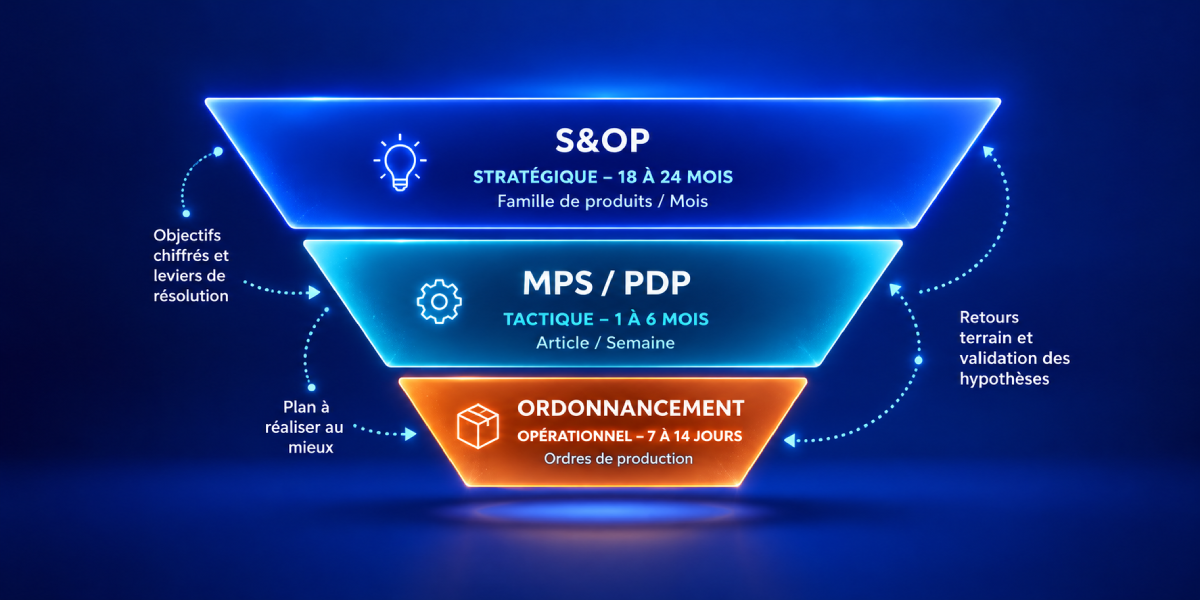
These three levels form a decision-making cascade with increasing granularity: product families at S&OP level, individual SKUs at MPS level and manufacturing orders at the production scheduling level. Strategic decisions flow down towards operations, while real-world adjustments and constraints are communicated back to higher levels. Their shared objective is to maintain the balance between demand and capacity, ensuring that every operational decision remains aligned with the company’s overall strategy.
Yet the relationship between S&OP, MPS and production scheduling is often poorly understood. Unclear boundaries between processes, informal interactions and insufficient feedback from operations can lead to misaligned plans, poorly calibrated inventory levels and limited responsiveness to disruptions. This article explores the roles, scope and interactions of each planning level, along with the key factors that improve their effectiveness and overall industrial performance.
S&OP is a strategic and tactical planning process operating over a rolling horizon of 18 to 24 months, although this may vary depending on the typical lead times of the industry concerned. It aligns Sales, Supply Chain, Production and Finance around a consistent, shared action plan.
Planning outputs are generally aggregated by product family, broad product category, manufacturing site, production line or group of production lines. However, this level of aggregation does not mean that calculations cannot be performed at a more detailed level. Where business requirements justify it, greater granularity can improve the accuracy of decision-making.
S&OP follows a structured cycle consisting of four or five complementary stages.
S&OP receives forecasts from Demand Planning, together with commercial opportunities and risks requiring consideration. Its role extends far beyond simply consolidating data. It validates the production capacity approach and defines how demand should be allocated between manufacturing sites, production lines or manufacturing methods. It also ensures that logistics planning and transport capacity are aligned across the entire planning horizon.
By anticipating future challenges, S&OP helps resolve potential tensions before they become operational crises. This includes workforce decisions, inventory policies, production planning and procurement requirements. It also guides purchasing strategy through improved medium- and long-term visibility, while strengthening supplier collaboration around capacity commitments and forecast volumes. Constraints identified at MPS level are escalated to S&OP when adjustments to the overall planning framework are required.
MPS, or Master Production Schedule, is a tactical production planning process typically covering a horizon of approximately weeks 1 to 13. Decisions are made at individual item or SKU level, by week and production line. While S&OP generally follows a monthly cycle, MPS operates on a weekly basis. This higher frequency provides greater responsiveness to short-term changes in demand.
MPS uses forecasts from Demand Planning to generate a detailed production plan by SKU and production line. It incorporates S&OP decisions regarding target inventory levels, approved capacity, production advancement or postponement strategies, and customer prioritisation. It also considers available inventory, confirmed orders and work in progress. Operational planning rules are integrated into the process, including batch sizes, production cycles, target inventory coverage and simplified production sequencing constraints.
MPS receives the capacity framework established by S&OP, along with detailed forecasts from Demand Planning. Its output is a master production schedule that feeds material and component requirements planning. When delays or shortages occur, MPS escalates constraints to S&OP so that the capacity framework can be adjusted.
Production scheduling is an operational execution process managed at plant level, whereas S&OP and MPS are generally managed centrally. It operates over a short horizon, ranging from a few days to two or three weeks. Its planning granularity is directly executable: manufacturing orders, workstations, teams and hours. The objective is to sequence operations to optimise resource utilisation and meet committed delivery deadlines.
Production scheduling assigns manufacturing orders to available resources, including machines, production lines and teams. It considers changeover times, resource availability and production priorities. It also incorporates the activities required for day-to-day plant operations, including planned maintenance and regulatory constraints. Production scheduling must also respond to disruptions such as equipment breakdowns, staff absences, supplier delays and urgent customer requests. Optimisation focuses on very short-term capacity utilisation and minimising idle time.
Production scheduling receives information on component availability and production programmes generated by MPS. At this level, executable manufacturing orders are created for shop-floor operations. Deviations between planned and actual production, along with capacity constraints, are reported back to MPS so that the master production schedule can be adjusted.
The three processes operate as a cascade. S&OP translates strategic objectives into a production planning framework. MPS converts this framework into production programmes planned by SKU. Production scheduling then organises their day-to-day execution at plant level. At each stage, feedback loops communicate actual operational constraints to higher planning levels, enabling continuous adjustments to the plans.
Several risks can undermine overall planning consistency.
Five factors underpin an effective planning system capable of addressing these challenges.
A platform such as Anaplan enables end-to-end consistency across planning levels. Teams can simulate scenarios in real time, track decisions and quickly identify the causes of deviations. Collaboration between Sales, Supply Chain, Production and Finance is supported by a shared data model, eliminating duplicate data entry and inconsistencies between systems. This strengthens decision-making agility: rebuilding scenarios in response to changing demand or manufacturing constraints can take hours rather than weeks.
Anaplan is particularly well suited to S&OP and MPS. Production scheduling, however, requires some clarification. In most cases, detailed scheduling involving complex constraints, such as multi-resource sequencing, changeover times and real-time availability, is better handled by a dedicated Advanced Planning and Scheduling (APS) solution.
Anaplan can support time-series-based scheduling or generate manufacturing orders using simple rules, with daily granularity, straightforward operational constraints and short planning horizons. Beyond this scope, a specialised tool is generally more appropriate.
At OneHive, we co-design tailored planning models that reflect the specific requirements of each industrial organisation. Implementation can begin with either S&OP or MPS, depending on the client’s level of maturity, before progressively expanding the scope. Our combined business and technical expertise helps ensure user adoption and the robustness of models in production. Because a planning tool only creates value when people actually use it.
S&OP, MPS and production scheduling are three complementary and interdependent processes. Each operates over a different horizon, at a different level of granularity and with distinct objectives. Overall performance depends less on the sophistication of each individual process than on the consistency of the interactions between them.
Aligning planning horizons, sharing data, structuring feedback loops and clarifying governance are essential conditions for effective industrial planning. A platform such as Anaplan can accelerate this alignment, provided it is supported by strong business expertise and a clear understanding of what each planning level must deliver.
If you would like to assess your organisation against these principles, identify areas of friction or evaluate the most suitable implementation roadmap with Anaplan, our teams can provide a structured, practical perspective.
A qualified engineer with a dual French-Brazilian degree, Cecilia supports OneHive’s clients in transforming their planning processes and deploying Anaplan solutions. Specialising in supply chain and integrated planning (S&OP / IBP), she is involved throughout the entire project lifecycle, from defining requirements through to go-live, including design, training and user support. Her experience in the luxury and agri-food sectors enables her to combine an understanding of business challenges with technical expertise to lead deployments on an international scale.

behind the article
Supply Chain Planning
Transformation of supply chain planning operations at a major French perfumes and cosmetics group, in partnership with Argon & Co
October 9, 2026
AI and planning progress together. The question remains: where does the real value lie?
October 1, 2026
Agentic Enterprise, AI and Connected Planning: join us in Madrid

A graduate of Arts et Métiers ParisTech with a Master’s degree in Mechanical Engineering, Etienne supports OneHive’s clients in their Supply Chain transformation and planning optimization projects. As a certified Anaplan Model Builder, he specializes in Demand Planning, Supply Planning, S&OP, and inventory optimization, combining functional expertise with technical capabilities. With experience across a wide range of Supply Chain and operations strategy projects, he helps organizations improve their planning processes, enhance operational performance, and implement tailored digital solutions to support business transformation.

Our latest news
Supply Chain Planning
Transformation of supply chain planning operations at a major French perfumes and cosmetics group, in partnership with Argon & Co
October 9, 2026
AI and planning progress together. The question remains: where does the real value lie?
October 1, 2026
Agentic Enterprise, AI and Connected Planning: join us in Madrid

A graduate of École Centrale Paris, Mathis has supported OneHive’s clients for more than five years in designing and deploying planning solutions. Specialising in highly complex modelling challenges, he acts as an expert across the entire project lifecycle, from scoping through to go-live, ensuring design consistency, solution robustness and compliance with OneHive quality standards.
He is recognised for his expertise in ESG topics, upstream Supply Chain processes (including MPS and procurement) and in modelling challenges specific to the agri-food industry.

Our latest news
Supply Chain Planning
Transformation of supply chain planning operations at a major French perfumes and cosmetics group, in partnership with Argon & Co
October 9, 2026
AI and planning progress together. The question remains: where does the real value lie?
October 1, 2026
Agentic Enterprise, AI and Connected Planning: join us in Madrid

A graduate of École Centrale Paris, Mathis has supported OneHive’s clients for more than five years in designing and deploying planning solutions. Specialising in highly complex modelling challenges, he acts as an expert across the entire project lifecycle, from scoping through to go-live, ensuring design consistency, solution robustness and compliance with OneHive quality standards.
He is recognised for his expertise in ESG topics, upstream Supply Chain processes (including MPS and procurement) and in modelling challenges specific to the agri-food industry.
Our latest news
Supply Chain Planning
Transformation of supply chain planning operations at a major French perfumes and cosmetics group, in partnership with Argon & Co
October 9, 2026
AI and planning progress together. The question remains: where does the real value lie?
October 1, 2026
Agentic Enterprise, AI and Connected Planning: join us in Madrid

After 13 years in operational consulting at Argon & Co, Florian joined OneHive to scale our growth and strengthen how we run. He brings deep expertise in optimizing decision-making and operational processes, spanning supply chain planning, merchandise planning, and logistics, and in steering large-scale transformation programs. He has extensive sector experience across Luxury, Apparel/Textile, Dermo-Cosmetics, Life Sciences, and FMCG. Internally, Florian plays a pivotal role in people processes, with a focus on HR development (evaluations, training, recruiting). He is a graduate of Centrale Paris.

Our latest news
Supply Chain Planning
Transformation of supply chain planning operations at a major French perfumes and cosmetics group, in partnership with Argon & Co
October 9, 2026
AI and planning progress together. The question remains: where does the real value lie?
October 1, 2026
Agentic Enterprise, AI and Connected Planning: join us in Madrid

Jules supports OneHive’s clients in designing and deploying value-driven planning solutions, leveraging platforms such as Anaplan. He works across the full project lifecycle, from scoping business needs to implementation, ensuring consistency, robustness, and delivery excellence. He combines functional consulting with hands-on execution, with a strong focus on team alignment and user adoption. He is recognized for his expertise in Demand Planning, particularly in structuring forecasting processes and improving demand performance. A graduate of INSA Lyon, Jules is a Supply Chain Manager at OneHive, contributing to the development of expertise and the success of client projects.

Our latest news
Supply Chain Planning
Transformation of supply chain planning operations at a major French perfumes and cosmetics group, in partnership with Argon & Co
October 9, 2026
AI and planning progress together. The question remains: where does the real value lie?
October 1, 2026
Agentic Enterprise, AI and Connected Planning: join us in Madrid

An engineering graduate of CentraleSupélec, specialising in supply chain and operations management, Julian supports OneHive’s clients in the design and implementation of planning solutions on Anaplan. As a certified Anaplan Model Builder, he contributes to the transformation of demand planning, business planning and integrated S&OP/IBP planning processes. His experience in modelling enables him to contribute to defining requirements, building models and implementing collaborative workflows, particularly for forecasting, budgeting and production planning. His work in the luxury, retail and agri-food sectors allows him to combine an understanding of operational challenges with data analysis and technical expertise.

Our latest news
Supply Chain Planning
Transformation of supply chain planning operations at a major French perfumes and cosmetics group, in partnership with Argon & Co
October 9, 2026
AI and planning progress together. The question remains: where does the real value lie?
October 1, 2026
Agentic Enterprise, AI and Connected Planning: join us in Madrid